LIQUID COMPLEX FERTILIZER ECONOM 5-20-5

HISTORY OF LIQUID COMPLEX STARTER FERTILIZERS AND EFFECTS OF THEIR APPLICATION
Starter fertilizers appeared as a response to the need of plants for quickly available nutrition at the early stages of development. Until the 20th century, fertilizers were mainly applied as a spread while plowing. In the 1920s-1950s, local application of phosphorus near the seed began to be practiced in the USA and Europe – the first steps towards IN-FURROW technology.
In the 1960s-1980s, the term starter fertilizers appeared – starter fertilizers, which are applied during sowing and quickly activate growth. In the 1980s-1990s, liquid forms (LCF), convenient for application through seed drills, were actively developed.
Since the 2000s, starter fertilizers have been actively introduced in Ukraine due to the development of precision agriculture. The modern stage is a combination of LCF (liquid complex fertilizers) with growth stimulants for maximum effect at the start, which are applied according to IN-FURROW technology – this is a method of application directly into the seed furrow during sowing.
The formulations are applied together with the seeds. To implement IN-FURROW technology, a seed drill with a system for applying liquid or granular foormulations into the furrow is required. Such a system can be built in by the equipment manufacturer or installed additionally.
DOLINA company offers liquid complex starting fertilizers ECONOM®, which provide an active start to plant development due to ideal solubility, the possibility of local application and compatibility with other formulations.
APPLICATION OF LIQUID COMPLEX STARTER FERTILIZERS ECONOM® CONTRIBUTES TO:
- faster germination and uniformity of seedlings;
- formation of a developed root system;
- enhanced initial plant growth;
- better plant resistance to abiotic stresses;
- more successful competition with weeds;
- earlier flowering before the onset of the heat stress period;
- more efficient use of moisture;
- earlier ripening and reduction of grain moisture when harvesting, and therefore, reduction of drying costs;
- increased yield under conditions of low temperatures at the beginning of the growing season.
PLANTS NEED MORE THAN JUST NPK
Liquid complex starter fertilizers ECONOM® contain functional complexes that were created taking into account the specifics of the application of RCF. We offer you a P-fixation inhibitor which protects phosphorus from pH fluctuations, and a complex of biologically active substances.
P-FIXATION INHIBITOR THAT PROTECTS PHOSPHORUS FROM PH FLUCTUATIONS
PH fluctuations, fixation by iron, aluminum or calcium salts, biological inertness – all this reduces the effectiveness of even high-quality phosphorus fertilizers.
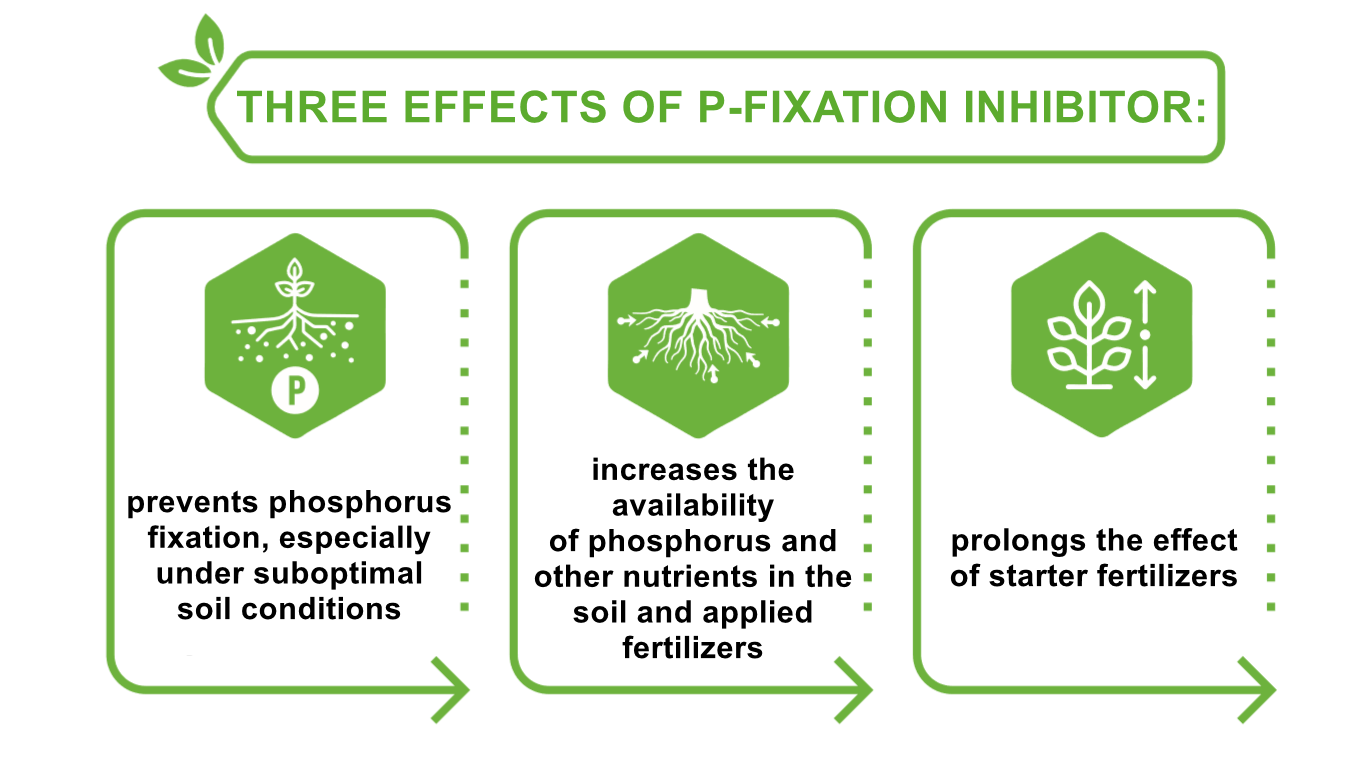
P-fixation inhibitor stabilizes phosphorus in the root zone, thereby protecting it from fixation and ensuring its availability during critical growth phases.
The pH level of the soil affects the availability of nutrients, especially phosphorus (P) and trace elements, changing the form of nutrients. Directly or indirectly, pH affects the solubility of these elements and determines their biological availability and mobility in the soil.
The corelation between soil pH and P availability
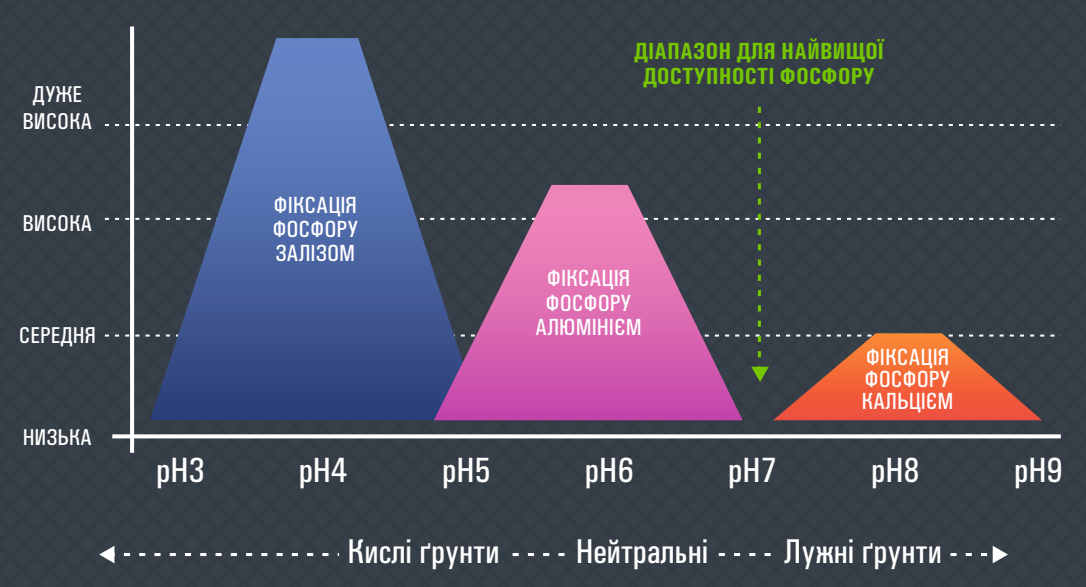
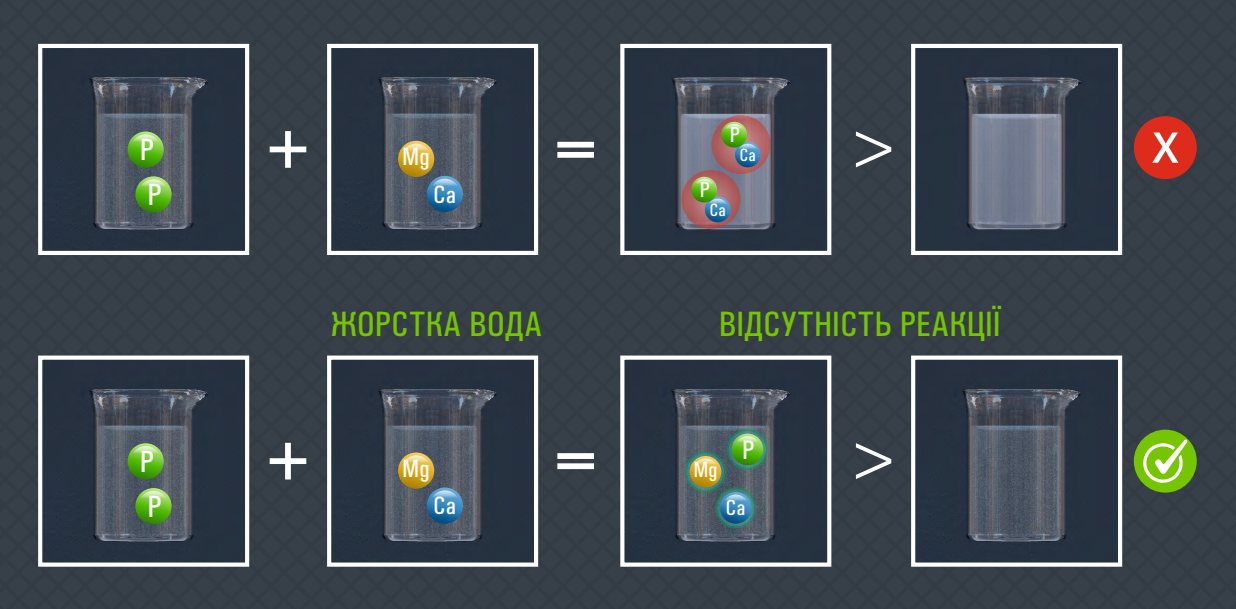
In alkaline soils (pH above 7.5), phosphate ions react with calcium (Ca) and magnesium (Mg), forming sparingly soluble compounds. In acidic soils (pH below 5.5), phosphorus (P) reacts with aluminum (Al) and iron (Fe), forming insoluble phosphates. Phosphorus protection technology is based on the use of a buffer system, which acts by creating a buffer and blocking the negative interaction of phosphorus with antagonistic positively charged ions (Ca2+, Fe3+ or Al3+), which can bind and limit the availability of P to the plant, especially in suboptimal soil pH conditions.
P-FIXATION INHIBITOR PROTECTS PHOSPHORUS NOT ONLY IN THE SOIL, BUT ALSO IN THE TANK MIXTURE WITH HARD WATER
ECONOM® RCF INCLUDES A COMPLEX OF BIOLOGICALLY ACTIVE SUBSTANCES
The complex, in terms of its biological activity, has a similar effect to plant root exudates that stimulate rhizosphere processes:
- increases soil microbial activity and improves nutrient absorption;
- provides an available source of energy for beneficial microbiota, promotes active reproduction of microflora, even under unfavorable conditions for its growth;
- stimulates the development of the root system;
- activates stress resistance at the initial stages of development.
ADVANTAGES of ECONOM® 5-20-5:
- buffer system to protect phosphorus from pH fluctuations – increases the effectiveness of phosphorus in acidic or alkaline environments;
- a complex of biologically active substances which activates root processes, increasing the utilization rate of nutrients by plants;
- available orthophosphate form of phosphorus;
- less dependence on arid conditions;
- effective absorption at low soil temperatures;
- high efficiency at low application rates;
- absence of ballast salts (chlorides, etc.) and harmful impurities;
- safety for plants at optimal rates;
- neutral pH;
- low salt index (safe for seedlings and leaves);
- no corrosion of equipment;
- low crystallization temperature;
- ideal option of simultaneous application with microelements, pesticides and biofertilizers.
APPLICATION RATES
LIQUID COMPLEX STARTER FERTILIZER ECONOM® 5-20-5 IS AN EFFECTIVE SOLUTION FOR:
- SOIL APPLICATION (IN-FURROW TECHNOLOGY). APPLICATION RATE 20-90 L/HA:
| Crops | Application | Application rate, L/ha |
| Corn, sunflower, soybean, sugar beet | Soil application (in-furrow technology) during sowing | 20 – 50 |
| Grain crops, rapeseed | 30 – 90 |
- LEAF SPRAYING FOR THE PURPOSE OF CORRECTING PLANT NUTRITION WITH NITROGEN, PHOSPHORUS AND POTASSIUM
| Grain crops, rapeseed, corn, sunflower, soybean, sugar beet | Leaf treatments | 3 – 7 |
Fertigation. To prepare the irrigation mixture, 5 L of fertilizer must be dissolved in at least 1000 L of water. The total fertilizer consumption on average is from 50 to 100 L/ha during the growing season. The daily fertilizer consumption rate ranges from 1-10 liters, depending on agronomic needs.