Microfertilizer with sulfur ORAKUL SULFUR ACTIVE
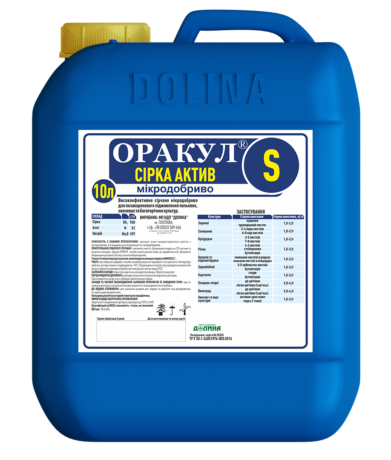
ORAKUL® sulfur active is a high-efficient sulfur micronutrient fertilizer with sulfur for foliar feeding of field, vegetable and perennial crops.
The formulation eliminates effectively sulfur deficiency in plants. it does not contain any ballast additives, so it does not cause leaf burn. It is completely absorbed through the leaf surface of plants.
Sulfur regulates the growth of the vegetative mass, increases crop productivity and survivorship rate of plants. Sulfur is involved in the formation of proteins.
Sulfur has a positive effect on the resistance of plants to diseases such as Alternaria blight and Botrytis. It is a part of amino acids that comprise the protein. Sulfur is involved in the formation of nucleic acids. It enhances the fixation of nitrogen from the atmosphere, as it affects positively nodulation in legumes.
Crops, which are in the greatest need in sulfur are cruciferous, legumes, sugar beet, onion, garlic and potatoes.
The need in sulfur depends on the level of nitrogenous nutrition: the higher is the level of nitrogen, the more plants absorb sulfur . In the spring, as a rule, sulfur content in the root zone of soil is low as sulfates are highly mobile.
Due to a lack of sulfur, marble spots are observed on young leaves, and the color of the leaves ranges from yellow to red. Upper leaves are first to experience the deficiency of sulfur.
Foliar application of ORAKUL® sulfur active contributes to improvement of plant nutrition. Sulfur, which is a compound of fertilizer, increases the percentage of protein and starch in wheat, oil content in sunflower, soybean and rapeseed. Sulfur in ORAKUL® sulfur active is in partially reduced form (polysulfides). This allows the plants to include it into the biosynthesis of amino acids and proteins with less energy expenses.
One more element, which is a part of ORAKUL® sulfur active, is sodium. Sodium ions have a function of plant osmotic regulation, like potassium. Sodium is essential for the substance transport through membranes. Therefore, containing sodium, ORAKUL® sulfur active has got a positive effect on the growth of most plants, especially sugar beet. It increases the sugar content, resistance to drought and increases leaf area.
When preparing the tank mix, the first thing you need to do is add micronutrient fertilizer ORAKUL® sulfur active.
Nitrogen in the sulfur microfertilizer is in reactive form (amide), which enhances root development.
The sulfur microfertilizer contains water softener, therefore the use of plant protection products in hard water (high content of Ca2+ and Mg2+ salts) in conjunction with ORAKUL® sulfur active does not reduce their effectiveness. Hardness salts are reliably bound by the formulation component, without causing turbidity of the spraying solution. There is no danger of the calcium sulphate (gypsum) formation, which can lead to breakdown of spraying machinery. When conducting treatments use а freshly mixed solution.
The composition of the microfertilizer allows its application, when air temperature exceeds +5°C.
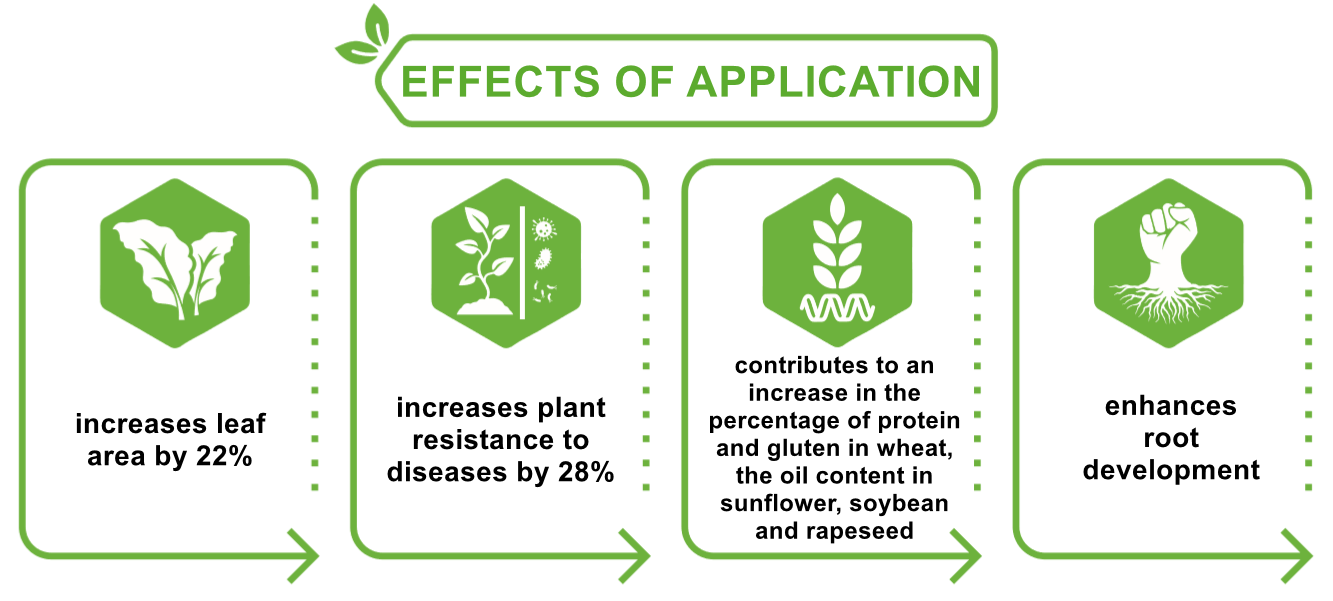
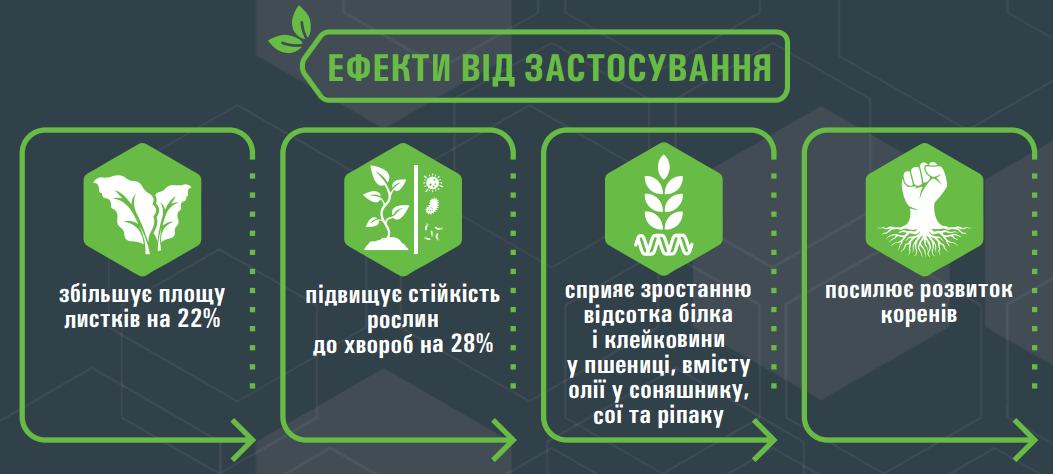
- increases leaf area by 22%;
- increases disease resistance of plants by 28%;
- contributes to increase of protein and starch content in wheat, oil content in sunflower, soybeans and rapeseed;
- enhances root development;
- improves plant nutrition.
It is recommended for use in conjunction with VIMPEL 2® plant growth stimulant.
It is recommended to add the formulation ORAKUL® sulfur active at a rate of 2-4 L per 100 L of UAN for plant nutrition in the early spring period. Such an agronomic measure eliminates the problem of UAN crystallization, provides plants with easily accessible sulfur, promotes effective nitrogen absorption, which activates plant regeneration after winter, their active growth and development.
APPLICATION OF THE FORMULATION AS A MICROFERTILIZER
| Crops | Period | Rate, L/ha |
|---|---|---|
| Spiked cereals | tillering flag leaf | 1.0 – 2.0 |
| Corn | 3-5 leaves 7-8 leaves | 1.0 – 3.0 |
| Legumes | 3-5 ternate leaves bud formation | 1.0 – 3.0 |
| Sunflower | 2-4 pairs of leaves 6-8 pairs of leaves | 1.0 – 3.0 |
| Rapeseed | 4-6 leaves bud formation | 1.0 – 3.0 |
| Sugar and fodder beet | closure of leaves in rows closure of leaves between rows | 1.0 – 3.0 |
| Potatoes | sprouts bud formation | 1.0 – 3.0 |
| Grapes | before flowering after flowering (fruit set) | 2.0 – 4.0 |
| Orchards and berries | before flowering after flowering (fruit set) | 2.0 – 4.0 |
| Vegetables and other crops | intensive growth (in 2 weeks) | 1.0 – 3.0 |
FUNGICIDAL TREATMENT
| CROPS | DISEASES, PESTS | RATE, L/HA | PERIOD | MAXIMUM AMOUNT OF TREATMENTS |
|---|---|---|---|---|
| Grapes | Downy mildew, spider mites | 2.0–4.0 | Spraying during the growing season depending on phytosanitary forecasts | 4 |
| Orchards (appletree, peartree) | Powdery mildew, fruit mites | 2.0–4.0 (5.0*) | 4 | |
| Currants, gooseberries | American gooseberry mildew, mites | 2.0–4.0 | 3 | |
| Rapeseed | Powdery mildew, alternaria blight | 4.0–5.0 | 2 | |
| Cereals (wheat, barley) | Powdery mildew | 2.0–3.0 | 2 | |
| Sugar beet | Powdery mildew, cercosporiosis | 2.0–4.0 | 2 | |
| Cucumbers | Powdery mildew, spider mites | 2.0–4.0 | 3 | |
| Watermelon, melon | Powdery mildew, anthracnose | 2.0–4.0 | 3 |
*side effect on mites (if the rate exceeds 2.0 L/ha)
1. INFORMATION FOR CONSUMERS: when applying the micronutrient fertilizer ORAKUL® sulfur active with the formulations, which acidify the aqueous solution (pH≤7), toxic hydrogen sulfide forms, which is firstly dangerous for field staff, and secondly leads to a slight decrease in the concentration of sulfur in the solution.
When mixing microfertilizers with metal-containing formulations (depending on the amount and type of the metal), the formation of a small amount of poorly water-soluble metal sulfides is possible. It should also be noted that finely dispersed sulfur may form sediment before the solution reaches the leaf surface. In this case, keep in mind that the mixing tool should be switched on during spraying.
The best option is to use the formulation ORAKUL® sulfur active and alkaline formulations as well as formulations that do not contain metal atoms simultaneously. In this case, when sprayed on a leaf surface, the aqueous solution containing sulfur microfertilizer begins to form active sulfur intensively and distributes evenly on a leaf surface.
The efficacy of the formulation and its ease of use depend on the application, storage and transportation conditions specified by the manufacturer.
2. COMPATIBILITY WITH OTHER FORMULATIONS: the micronutrient fertilizer is applied during the growing season either prophylactically or according to the diagnostics results based on the application regulations. It performs well in tank mixes with plant growth stimulator VIMPEL 2®. Recommended water temperature for a preparation of the working tank solution is 18 – 20 ºС (64.4 – 68 ºF). The micronutrient fertilizer is compatible as well with the pesticides that do not create an acidic environment in the spraying solution.
3. PREPARATION OF WORKING TANK SOLUTION:
Warning! Prior to starting preparation of a tank mix, always check the formulations for compatibility!
For this purpose take a container, pour in it some water (which is to be used for the main application), add the tank mix components in proportions, based on the field rates of consumption. After closing the container, mix the contents by shaking it 10-15 times. Evaluate the tank mixture visually twice: immediately after mixing and after the mixture has settled (in about 30 minutes). Incompatibility of formulations is indicated by their separation into layers, residuum occurrence, flocculation of the mixture, formation of sludge that does not disperse.
Attention! It is possible to use the formulation in hard water due to the water softener in its composition. At the same time, if there is high concentration of hardness salts and significant amount of water, it is possible that after some time there will be a slight separation of hardness salts in the form of gypsum (СаSO4٠2H2O). In this case, the amount of sulfur in the solution is slightly reduced. These processes in no way affect the solution usability or cause the possibility of spraying equipment failure, as the formulation is finely dispersed. When forming a tank mixture in hard water, we recommend spraying with the mixing mode turned on. After application of the tank mix, it is necessary to rinse the tank with water to prevent the overgrowth of gypsum crystals.
If there are no compatibility problems, prepare the working solution just before spraying (direct application). Shake the product thoroughly in the original package and pour it directly into the sprayer tank, which is to be previously filled with water to 2/3 of its volume. After this with the mixing mode turned on add the components of the tank mixture in sequence stated in the recommendations and finish the process with filling the tank with water. Stirring of the mixture should be continued throughout the period of its preparation, as well as during application.
Application rates of the spraying solution: field crops — 70-300 L/ha, vegetables — 300-400 L/ha, fruit crops and grapes — 800-1000 L/ha.
4. MIXING ORDER OF SPRAYING SOLUTION COMPONENTS: when preparing the tank mixture, stick to the following sequence of components.
Tank mix
- Water
- ORAKUL® sulfur active
- Plant growth regulators
- Plant protection products
- Other micronutrient fertilizers
- Water
- Water
- ORAKUL® sulfur active
- Plant growth regulators
- UAN according to the foliar application recommendations 3-12%+2,5% MgSO4٠7H2O (5% Decahydrate)
- Plant protection products
- Micronutrient fertilizers
- Water
- Water
- ORAKUL® sulfur active
- Plant growth regulators
- Urea according to the foliar application recommendations using other liquor (either into the sprayer tank or on the filter)
- Plant protection products
- Micronutrient fertilizers
- Water
Attention! In preparing a tank mix, care should be taken to ensure that the mixing of the components (such as growth regulators, PPPs, microfertilizers, etc.) is conducted solely in water!
5. APPLICATION REQUIREMENTS: spraying should be done either early in the morning or in the evening, when the humidity level is high to avoid chemical leaf burn. The optimum air temperature is +10…+25 °С (50 — 77 ºF), wind speed up to 5 — 7 m/s depending on the sprayer type. It is not recommended carrying out spraying operations during foggy weather or in the presence of dew, which can lead to surface overflow of the solution and hence the reduction of the treatment efficiency. The spraying should be stopped 1.5 — 2 hours before the rain.
Attention! Use а freshly mixed solution. Do not store the prepared solution more than 24 hours.
6. STORAGE AND TRANSPORTATION: storage and transportation must be carried out in accordance with ГОСТ 14189 (National State Standard).
The formulation should be stored in a warehouse or storage building, designed specifically for this purpose. Storage area should be free of direct sunlight, moisture, pollution and mechanical damage to the container. Store at temperature above 0 ºС below +30 ºС (50 — 86 ºF), in the original closed package in an upright position, with the cap facing up in a cardboard box. Do not stack cardboard boxes more than 3 high.
Decrease of temperature below -20 ºС (-4 ºF) results in the product decrease of viscosity, the prolonged storage may cause sediment formation.
Any form of transport is possible while in covered vehicles. The use of open vehicles, which provide protection against precipitation, is allowed as well.
According to the conformity №255313/1 of the Ukrainian Cargo Bureau, State Research and Development Institute of the Merchant Marine of Ukraine of the Ministry of Infrastructure of Ukraine is not classified as dangerous cargo and is shipped as safe cargo under general conditions.
7. WHO CLASSIFICATION, TOXICITY: 4th toxicity class. The formulation is nontoxic, does not cause allergies, is environmentally friendly and absolutely harmless to pollinating insects.
8. PRECAUTIONS: keep away from children and animals. When carrying out spraying operations, use the appropriate and adjusted equipment, follow generally accepted safety standards.
9. FIRST AID INSTRUCTIONS: if the skin or eyes are contaminated with the preparation, flush them with water. If necessary, call a doctor.
10. CONTAINER AND LEFTOVER FORMULATION DISPOSAL: a container and leftover formulation do not require specific methods of disposal and neutralization.
11. STORAGE PERIOD: 5 years.
12. TECHNICAL REGULATION: ТУ У 20.1-24051976-003:2016.
13. CERTIFICATE OF STATE REGISTRATION: series А, № 05205.
14. VOLUME OF PACKAGES: 1 L, 5 L, 10 L.
15. HYDROGEN-ION INDICATOR (pH), units: 11.8 ± 0.5.
16. DENSITY, g/cm3: 1.331 ± 0.005.
17. COLOR (visually): dark orange.
18. ODOUR (organolept.): hydrogen sulphide.
ORAKUL® sulfur active is a product created for farmers, which allows you to get a protective effect on the plant in three or more directions of action.
ORAKUL® sulfur active is a formulation that not only effectively compensates for the lack of sulfur, but also has powerful fungicidal and acaricidal properties. The unique composition of the formulation ORAKUL® sulfur active provides high biological effectiveness in resistance to powdery mildew, American gooseberry mildew, mites and preventing the development of gray rot and alternaria blight. In the dissolved state, the formulation forms structures that create highly dispersed submicron sulfur particles, which ensure the fastest possible penetration of the active substance into leaf tissues.
ORAKUL® sulfur active is superior in biological activity to inorganic fungicides, which include colloidal ground sulfur. The fact is that the formulation ORAKUL® sulfur active is a selected composition of inorganic oxygen-containing and oxygen-free sulfur compounds with alkali metals, as well as inorganic compounds containing nitrogen in various forms. In the process of dissolution and reaction with oxygen, nanoparticles of molecular sulfur with average sizes of 20–25 nm (nanometers, 10-9 m) are formed. For comparison: the size of the cell nucleus is 10 μm (500 times larger than a sulfur particle), the stomatal gap is 16×4 nm, and the cell itself reaches 20 μm (1000 times larger than a sulfur particle).
As for formulations based on colloidal ground sulfur, they are produced using conventional mechanical grinding, which does not allow obtaining finely dispersed sulfur particles (with an average particle size of less than 8 μm). This feature of sulfur is mainly explained by its low melting point, which does not allow for intensive mechanical processing, since during intensive grinding the powder heats up and the sulfur particles begin to stick together, forming agglomerates.
The penetration of sulfur does not occur mechanically through pores and open stomata, but mainly by physical diffusion through the cuticle and modified epidermal structures, such as stomatal cells and trichomes. Therefore, the small particle size allows the active substance to be evenly distributed over the surface of the leaves, to penetrate into the leaf tissues in a short time and effectively eliminate the lack of sulfur in the tissues or resist diseases.
According to the results of the research, ORAKUL® sulfur active has at least 4 times more powerful fungicidal effect than conventional colloidal sulfur, which was proven at the Magarach Institute within the framework of tests against powdery mildew on grapes. Example of the calculation: standard (colloidal sulfur) – 5 kg/ha x 800 g/kg=4 kg/ha of sulfur, ORAKUL® sulfur active – 304 g/l x 3.5 l/ha=1 kg/ha.
DYNAMICS OF POWDERY MILDEW SPREAD AND EFFECTIVENESS OF FORMULATIONS, VARIETY BASTARDO MAHARACHSKY, INSTITUTE FOR GRAPES AND WINE “MAHARACH”
| VARIANT | SPREADING (ON CLUSTERS), % | SPREADING (ON LEAVES), % | TECHNICAL EFFICIENCY (ON CLUSTERS), % | TECHNICAL EFFICIENCY (ON LEAVES), % |
| I. Control | 100 | 64,0 | – | – |
| II. Standard (colloidal sulfur) (7 times treatment), 5 kg/ha | 13.2 | 6.9 | 86.8 | 89.2 |
| III. ORAKUL® sulfur active (7 times treatment), 3.5 L/ha | 15.1 | 7.9 | 84.9 | 87.6 |
| НІР05 | 11.6 | 5.6 | – | – |
ORAKUL® sulfur active not only effectively inhibits the development of the disease, but also improves the quality of the wine material by increasing the sugar content of the juice.
Sufficient level of plant nutrition with an element such as sulfur is one of the key positions in the processes of vital activity, because it is sulfur that participates in the processes of formation of proteins and nucleic acids, regulates the growth of vegetative mass. Thereby it increases crop yield, increases the viability of plants in difficult environmental conditions. Sulfur promotes nitrogen fixation from the atmosphere, as it has a positive effect on the formation of nodules in leguminous plants.
The most in need of sulfur is cabbage, legumes, sugar beets, onions, garlic and potatoes. The need for sulfur depends on the level of nitrogen nutrition: the higher the dose of nitrogen, the more sulfur plants consume. In spring, a low sulfur content is observed in the root-containing soil layer due to the fact that sulfates are highly mobile.
Another property that favorably distinguishes ORAKUL® sulfur active from colloidal sulfur formulations is the temperature of activity of the active substance. Colloidal sulfur does not work as effectively when there is low temperature, especially when temperature drops below +15°C. This limits the possibility of its application in autumn and early spring. The use of oxygen-free sulfur compounds allows sulfur to be released almost regardless of the ambient air temperature.
Another element contained in ORAKUL® sulfur active is sodium. In plants, sodium ions perform an osmoregulatory function, similar to potassium. Sodium is important for the transport of substances through membranes. Therefore, having sodium in its composition, the formulation has a beneficial effect on the growth of most plants, especially sugar beets. It increases sugar content, drought resistance and leaf area.
ATTENTION! ORAKUL® sulfur active and its solution has a pungent odor. When nanosulfur is dissolved in water with other formulations, rapid clouding of the solution and the release of a pungent odor are observed. This is absolutely normal, since sulfur is in a finely dispersed nanostate at this time. This does not affect the quality of spraying in any way.
However, this fact does not exclude the preliminary mixing of the components for compatibility. The ban on application should be accepted only if there is a settled sediment for at least an hour from the start of the experiment.
With the sprayer tank mixer turned on, treatments can be carried out for a long time, while the filter or nozzles will not clog.
The only danger is the release of corrosive gas. During mixing, it is necessary to use personal respiratory protective equipment, at the same time this gas is also toxic to agricultural pests. Therefore, crop treatment can be considered as insectoacaricidal protection with a repellent effect.