STARTING PLANT GROWTH STIMULANT BLACK YAKIV
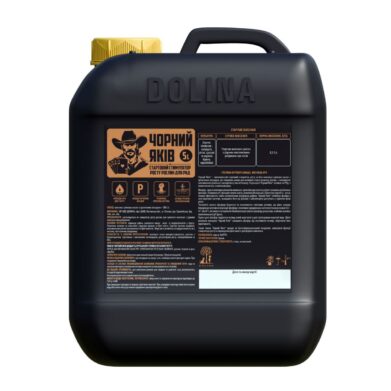
An effective start is the foundation of the future harvest. This is the principle that guides POP-UP and IN-FURROW technologies – methods of local nutrition used during sowing to improve the start of plants, root system development and yield increase. The history of starter fertilizers confirms: optimal nutrition during the first phases of growth is a key factor in the formation of a strong root system, rapid plant development and resistance to stress in subsequent growing periods.
HOWEVER, CLASSIC GRANULAR OR LCF FERTILIZERS, WHICH ARE TRADITIONALLY USED FOR STARTER FEEDING, HAVE A SOME SIGNIFICANT PROBLEMS AND LIMITATIONS.
If we are talking about granular starter fertilizers, the slow solubility of the granules in cool soil does not provide immediate access to nutrients in the first critical days after sowing.
LCF fertilizers, which are concentrated solutions of nitrogen and potassium salts, especially nitrates or chlorides, can cause phytotoxicity – burning of seedlings due to osmotic stress, which significantly reduces the energy of seed germination.
TO SOLVE THESE PROBLEMS, AS WELL AS TO ADDITIONALLY STIMULATE PLANT DEVELOPMENT, THE DOLINA COMPANY PRESENTS BLACK YAKIV® – A STARTING PLANT GROWTH STIMULANT FOR COMPLEX APPLICATION WITH GRANULAR AND LCF FERTILIZERS USING POP-UP AND IN-FURROW TECHNOLOGIES.
The properties of the substances that make up the formulation BLACK YAKIV® ensure the maximum degree of penetration into plant cells and their main organelles: nucleus, mitochondria, chloroplasts. Studies have shown that this indicator is influenced by the molecular weight. Humic substances of the formulation BLACK YAKIV® have an optimal molecular weight of 8400±600 and are able to effectively saturate plant cells, fully revealing their potential when it is needed.
TABLE 1. LEVEL OF SATURATION WITH HUMIC ACIDS WITH ORGANIC LIGANDS OF PLANT CELL ORGANELLES DEPENDING ON MOLECULAR WEIGHT.
| Molecular weight of humic acids with organic lagands | Per 500 mg of fraction | Per 100 mg of fraction | |
| nucleus | mitochondria | chloroplasts | |
| 500±100 | 30,4±3,4 | 63.4±6.3 | 201.8±20.4 |
| 8400±600 | 61,0±6,1 | 97.4±9.7 | 274.0±27.4 |
| 12000±2500 | 36,5±3,7 | 97.4±9.7 | 160.0±16.0 |
The complex of humic acids with organic ligands, which is part of the formulation BLACK YAKIV®, plays an important buffer and protective role in the soil and plant environment, reducing the negative impact of the high salt index of fertilizers. Humates act as ion exchangers that are able to temporarily bind cations (Na+ , K+ , NH4+, Ca2+). This reduces the osmotic concentration of salts in the immediate root zone (rhizosphere), thereby reducing the osmotic pressure that prevents the plant from absorbing water.
Phosphorus protection technology is based on the properties of humic substances that act by blocking the negative interaction of phosphorus with positively charged antagonistic ions (Ca2+, Fe3+ or Al 3+), which can bind and limit the availability of phosphorus to plants, especially in conditions of suboptimal soil pH. BLACK YAKIV® stabilizes phosphorus in the root zone, protecting it from fixation and ensuring its availability during critical growth phases.
Complex of humic acids with organic ligands:
- on carbonate and heavy soils, orthophosphate ions (H2PO4– /HPO42 –) very quickly bind to calcium, iron and aluminum cations, forming insoluble compounds (Ca3 (PO4)2, FePO4, etc.);
- humic acids, which are part of the formulation, due to the presence of numerous carboxyl and phenolic groups, intercept these cations and retain them in humate-calcium-phosphate complexes (COO– — Ca2+—O(PO3)).
HUMATE-CALCIUM-PHOSPHATE MATRIX
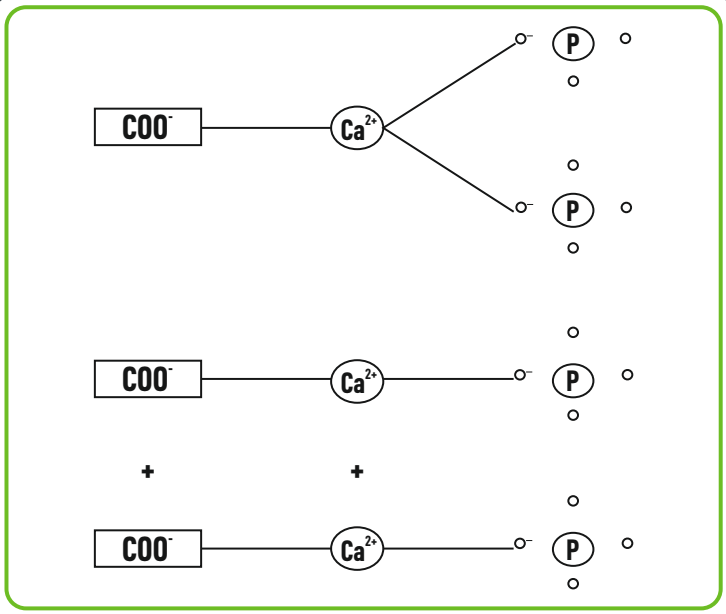
As a result, phosphorus is stored in the soil solution for a longer time and remains available to the root system. The plant easily absorbs orthophosphates from humate-calcium-phosphate complexes (COO– — Ca2+ — O(PO3 )), converting phosphorus into the most accessible form, which ensures the highest degree of penetration into plant cells due to the optimally selected molecular weight.
STIMULATING EFFECT OF THE STARTING PLANT GROWTH STIMULANT BLACK YAKIV®:
Improvement of seed germination. Humic complexes activate hydrolysis enzymes (amylases, proteases), which break down reserve substances in seeds; increase the activity of respiratory enzymes, enhancing energy metabolism; reduce delay in germination under low temperature conditions.
Stimulation of primary root formation if the preparation is applied directly to the seed. Humic substances act as auxin-like stimulants, activating the formation of coleoptile and root cap. The length of the primary root and the number of root hairs increase.
Regulation of water metabolism during the germination stage. Under the influence of active substances, seeds absorb water faster, which accelerates swelling and activation of cells. Water loss is reduced in conditions of lack of moisture (osmotic stabilization effect).
Anti-stress effect during early stages. The influence of abiotic factors is reduced: salinity, cold, herbicide background. The content of antioxidants in seedlings increases.
Formation of the starting photosynthetic apparatus. Humic substances stimulate the synthesis of chlorophyll already in the first leaves. The intensity of photosynthesis increases in the phase of 1-2 leaves, which lays the foundation for higher growth potential. These effects are realized during the initial application of the plant growth stimulant BLACK YAKIV® to the germination zone (for example, in POP-UP/INFURROW systems).
THE DIFFERENCE OF THE STARTING PLANT GROWTH STIMULANT BLACK YAKIV® FROM OTHER PRODUCTS BASED ON HUMIC SUBSTANCES:
It is well-known, that the main properties of humic substances, such as effective activity, solubility and stability, depend on the pH of the medium, which is associated with their structural and group composition. Humic substances are stably soluble in a neutral medium, but with a decrease or increase in pH, this property changes depending on the chemical composition and origin of the substances. This can lead to an effectiveness loss of the formulation in soil with a pH of up to 5.5 and above 7.0. The main task in solving this issue was to create a complex of humic acids with organic ligands and study their behavior in order to achieve stability in environments with different pH levels.
In alkaline medium, phenolic and carboxyl groups are deprotonated, which causes repulsion of negatively charged groups, and, as a result, molecules of humic substances have an extended configuration. If the pH decreases, the functional groups are protonated and the repulsion effects are minimized, eventually the molecules acquire a helical conformation. At this stage, the hydrophobic regions are in the interior of the structure, and the hydrophilic parts are in contact with the aqueous medium. This behavior is responsible for the micelle-like organization and the reduction of the surface tension of humic substances.
An increase in the concentration of hydrogen ions causes protonation of the carboxyl groups of humic substances, which ultimately leads to the precipitation of macromolecules. This process starts from pH = 5.5, and should be considered as continuous, which contributes to the aggregation of humic substances at the molecular level, and, as a result, the formation of a hydrophobic surface. Therefore, we can conclude that an acidic environment deactivates humic acid molecules.
The solution to the problem of creating humic complexes that will retain water-soluble properties and activity in acidic and alkaline environments was found by specialists from the company DOLINA after extensive research and modification of humates, which are used in the starting plant growth stimulant BLACK YAKIV® as the main active ingredient.
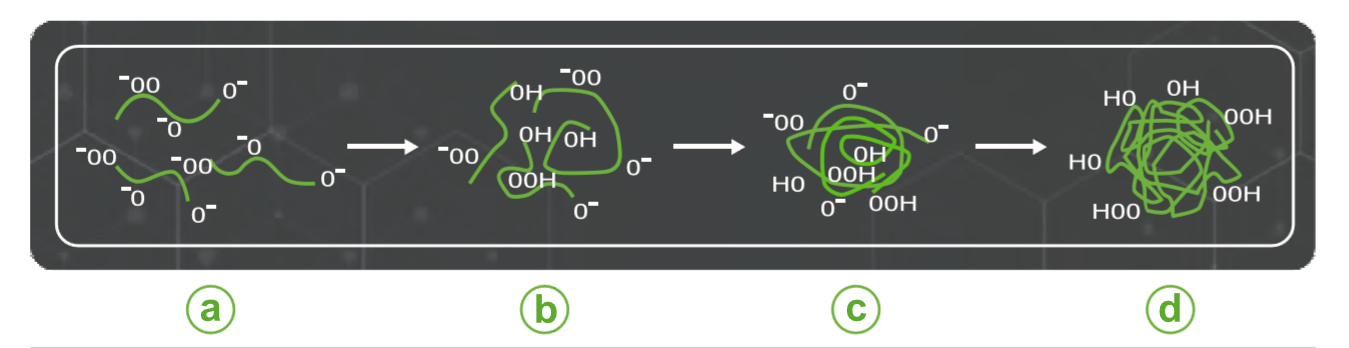
Behavior of humic substance molecules in an alkaline environment and the aggregation process due to a decrease in the pH of the medium:
a – repulsion of deprotonated groups, if pH>7;
b – intramolecular aggregation in the event of a decrease in the pH of the medium;
c – intermolecular aggregation in the event of a decrease in the pH;
d – precipitation of humic substances, if pH=5.5.
HUMATES INDEED PLAY AN IMPORTANT ROLE IN THE FORMATION AND STABILIZATION OF SOIL STRUCTURE. THEIR INFLUENCE ON SOIL AGGREGATION IS EXPLAINED BY SEVERAL MECHANISMS:
- the polyelectrolyte nature of humates. They are able to bind with calcium, magnesium, and iron cations. This contributes to the formation of stable aggregates that are less likely to collapse when moistened;
- “sticky” organic matrix. Humates act as a biopolymer glue that envelops small mineral particles. Such aggregates retain water and air better;
- protection against dispersion and erosion. Humates increase the water resistance of aggregates. In rainy weather or when watering, the soil floats less, does not form crusts, and lets the water pass more easily. This reduces the risk of erosion and compaction.
THUS, BLACK YAKIV® IS NOT JUST A “ADDITION”, IT WORKS AS A MULTIFUNCTIONAL TOOL THAT PERFORMS THE FUNCTIONS OF A GROWTH STIMULANT AND INCREASES THE EFFICIENCY OF PHOSPHORUS NUTRITION.
STARTING APPLICATON
| Crops | Period | Rate L/ha |
|---|---|---|
| Cereals, sunflower, corn, rapeseed, sugar and fodder beets, legumes | Starting application with liquid complex fertilizers during sowing | 0.3 – 0.6 |
BLACK YAKIV® IS ADDED TO THE TANKING MIXTURE LAST.
pH of the ECONOM LCF when adding BLACK YAKIV® – 6-7.