Microfertilizer ORAKUL colofermine of magnesium
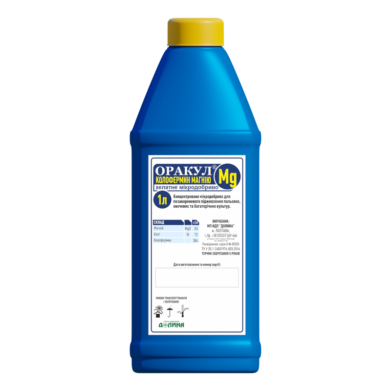
ORAKUL® colofermine of magnesium is a concentrated micronutrient fertilizer with magnesium for foliar feeding of field, vegetable and perennial crops.
- environmentally friendly, highly concentrated, liquid fertilizer, convenient and safe to use;
- due to its organic form, it penetrates better into plant tissues and is better absorbed;
- is compatible with pesticides, growth stimulants, fertilizer solutions with a wide range of pH (i.e. those which are applied on different soil types).

- magnesium deficiency results in the destruction of chlorophyll, the affect is more visible on older leaves;
- leaf veins remain green, while the areas of tissues located between the veins have a pale color (spotted, interveinal or marble chlorosis);
- the edges of leaves curl and die.
Which plants need magnesium the most?
- corn
- sorghum
- sugar beets
- potatoes
- legumes
- grapes
Which soils are deficient in magnesium and other factors affecting its absorption
 Magnesium deficiency can be observed in the sod-podzolic soils of light mechanical composition, as part of magnesium available to them is washed into deeper horizons. Cold spring and low pH level (<5.0) reduce the availability of magnesium present in the soil for plants.
What to do in case of magnesium deficiency?
Due to the application of the microfertilizer ORAKUL® colofermine of magnesium, the following occurs:
- photosynthesis is the most efficient due to prevention of the chloroplasts destruction and active chlorophyll regeneration;
- speeding up of the progress of growth processes and cell division;
- increased activity of enzymes;
- intensive water absorption by plant from the soil, increasing drought resistance;
- increased product quality.
Recommended application rate of the formulation:
The formulation does not crystallize. In low temperatures, it takes on a gel-like state, which changes to a liquid state if kept warm. The composition of the microfertilizer allows its application, when air temperature exceeds +5°C.
For the best effect is recommended to be applied in conjunction with the VIMPEL 2® plant growth stimulant.
APPLICATION
| Crops | Period | Rate, mL/10 L of water |
|---|---|---|
| Spiked cereals | tillering 2-3 applications every 10 – 14 days in the period of intensive growth | 20 – 30 |
| Corn, sorghum | 3-5 leaves next applications every 10 – 14 days | 30 – 40 |
| Legumes | 3-5 ternate leaves next applications every 10 – 14 days up to a cessation of intensive growth | 30 – 40 |
| Sunflower | 2-4 pairs of leaves next applications every 10 – 14 days | 20 – 30 |
| Rapeseed | renewal of the vegetation next applications every 10 – 14 days up to a cessation of intensive growth | 20 – 30 |
| Sugar and fodder beet | 4-6 leaves next applications every 10 – 14 days up to closure of leaves between rows | 30 – 40 |
| Potatoes | sprouts bud formation | 30 – 40 |
| Grapes | after flowering next applications every 10 – 14 days | 40 – 50 |
| Orchards and berries | after flowering (fruit set) next applications every 10 – 14 days | 40 – 50 |
| Vegetables and other crops | at the beginning of vegetation, next applications every 7 – 10 days up to a cessation of intensive growth | 20 – 30 |
1. INFORMATION FOR CONSUMERS: follow the instructions when using the formulation. The efficacy of the formulation and its ease of use depend on the application, storage and transportation conditions specified by the manufacturer.
2. COMPATIBILITY WITH OTHER FORMULATIONS: the micronutrient fertilizer is applied during the growing season either prophylactically or according to the diagnostics results based on the application regulations. It performs well in tank mixes with plant protection products (unless otherwise specified by the manufacturer of the plant protection products), urea (in the recommended concentrations when using foliar fertilization of agricultural crops according to the crop growth stages), UAN, plant growth regulators, microfertilizers and biological preparations.
3. PREPARATION OF WORKING TANK SOLUTION:
Warning! Prior to starting preparation of a tank mix, always check the formulations for compatibility!
For this purpose take a container, pour in it some water (which is to be used for the main application), add the tank mix components in proportions, based on the field rates of consumption. After closing the container, mix the contents by shaking it 10-15 times. Evaluate the tank mixture visually twice: immediately after mixing and after the mixture has settled (in about 30 minutes). Incompatibility of formulations is indicated by their separation into layers, residuum occurrence, flocculation of the mixture, formation of sludge that does not disperse.
Attention! It is possible to use the formulation in hard water. The active substances contained in it do not form compounds with hardness salts (СаSO4٠2H2О), hence the solution does not grow turbid.
If there are no compatibility problems, prepare the working solution just before spraying (direct application). Shake the product thoroughly in the original package and pour it directly into the sprayer tank, which is to be previously filled with water to 2/3 of its volume. After this with the mixing mode turned on add the components of the tank mixture in sequence stated in the recommendations and finish the process with filling the tank with water. Stirring of the mixture should be continued throughout the period of its preparation, as well as during application.
Application rates of the spraying solution: field crops — 70-300 L/ha, vegetables — 300-400 L/ha, fruit crops and grapes — 800-1000 L/ha.
4. MIXING ORDER OF SPRAYING SOLUTION COMPONENTS: when preparing the tank mixture, stick to the following sequence of components.
Tank mix
- Water
- Plant growth regulators
- Plant protection products
- ORAKUL® colofermine of magnesium
- Other micronutrient fertilizers (excluding ORAKUL® sulfur active)
- Water
- Water
- Plant growth regulators
- UAN according to the foliar application recommendations 3-12%+2,5% MgSO4٠7H2O (5% Decahydrate)
- Plant protection products
- ORAKUL® colofermine of magnesium
- Other micronutrient fertilizers
- Water
- Water
- Plant growth regulators
- Urea according to the foliar application recommendations using other liquor (either into the sprayer tank or on the filter)
- Plant protection products
- ORAKUL® colofermine of magnesium
- Other micronutrient fertilizers
- Water
Attention! In preparing a tank mix, care should be taken to ensure that the mixing of the components (such as growth regulators, PPPs, microfertilizers, etc.) is conducted solely in water!
5. APPLICATION REQUIREMENTS: spraying should be done either early in the morning or in the evening, when the humidity level is high to avoid chemical leaf burn. The optimum air temperature is +10…+25 °С (50 — 77 ºF), wind speed up to 5 — 7 m/s depending on the sprayer type. It is not recommended carrying out spraying operations during foggy weather or in the presence of dew, which can lead to surface overflow of the solution and hence the reduction of the treatment efficiency. The spraying should be stopped 1.5 — 2 hours before the rain.
Attention! Use а freshly mixed solution. Do not store the prepared solution more than 24 hours.
6. STORAGE AND TRANSPORTATION: storage and transportation must be carried out in accordance with ГОСТ 14189 (National State Standard).
The formulation should be stored in a warehouse or storage building, designed specifically for this purpose. Storage area should be free of direct sunlight, moisture, pollution and mechanical damage to the container. Store at temperature above 0 ºС below +30 ºС (50 — 86 ºF), in the original closed package in an upright position, with the cap facing up in a cardboard box. Do not stack cardboard boxes more than 3 high.
Decrease of temperature below -30 ºС (-22 ºF) results in the product decrease of viscosity, the prolonged storage may cause sediment formation.
Any form of transport is possible while in covered vehicles. The use of open vehicles, which provide protection against precipitation, is allowed as well.
According to the conformity №255313/1 of the Ukrainian Cargo Bureau, State Research and Development Institute of the Merchant Marine of Ukraine of the Ministry of Infrastructure of Ukraine is not classified as dangerous cargo and is shipped as safe cargo under general conditions.
7. WHO CLASSIFICATION, TOXICITY: 4th toxicity class. The formulation is nontoxic, does not cause allergies, is environmentally friendly and absolutely harmless to pollinating insects.
8. PRECAUTIONS: keep away from children and animals. When carrying out spraying operations, use the appropriate and adjusted equipment, follow generally accepted safety standards.
9. FIRST AID INSTRUCTIONS: if the skin or eyes are contaminated with the preparation, flush them with water. If necessary, call a doctor.
10. CONTAINER AND LEFTOVER FORMULATION DISPOSAL: a container and leftover formulation do not require specific methods of disposal and neutralization.
11. STORAGE PERIOD: 5 years.
12. TECHNICAL REGULATION: ТУ У 20.1-24051976-003:2016.
13. CERTIFICATE OF STATE REGISTRATION: series А, № 05205.
14. VOLUME OF PACKAGES: 1 L, 5 L, 10 L.
15. HYDROGEN-ION INDICATOR (pH), units: 7.0 ± 1.0.
16. DENSITY, g/cm3: 1.254 ± 0.02.
17. COLOR (visually): colorless.
18. ODOUR (organolept.): odourless.